Executive Summary & Early Pilot White Paper
Building Mental Health & Well-Being Infrastructure™: The WenWell™ Framework — Early Pilot Findings from WenWell Circles™
Dr. Wendy Garvin Mayo, DNP, APRN, ANP-BC
Abstract
Organizations across healthcare, education, and community settings continue to face increasing rates of stress, burnout, emotional exhaustion, compassion fatigue, and social isolation. Although many invest in wellness initiatives, few have implemented a structured, measurable system that intentionally develops emotional capacity, psychological safety, and meaningful human connection. WenWell Circles™ were developed to address this gap. Grounded in the WenWell™ Framework — Capacity, Psychological Safety, and Connection — WenWell Circles™ provide a structured, facilitator-led intervention that integrates guided reflection, storytelling, emotional intelligence, peer connection, and practical wellness strategies within a standardized process. An early pilot involving 121 nursing students and practicing nurses across Connecticut evaluated participant outcomes using standardized pre- and post-session assessments aligned with the WenWell™ Framework. Following participation in a single support circle, overall wellness scores increased from 3.57 to 4.09 (+0.52). Positive improvements were observed across every measured domain, with the largest gains occurring in Sustainability Confidence (+0.71), Stress Manageability (+0.68), and Stress Regulation Capacity (+0.60). These findings provide encouraging early evidence that WenWell Circles™ are a practical, scalable, and measurable intervention capable of strengthening workforce well-being while helping organizations build sustainable mental health and well-being infrastructure.
Keywords
Executive Summary
Organizations are investing millions of dollars in wellness programs, yet burnout, disengagement, workplace stress, turnover, and emotional exhaustion continue to rise. The challenge is not simply a lack of wellness programming — it is the absence of wellness infrastructure. Most wellness efforts focus on isolated interventions rather than creating environments where people consistently develop the skills, relationships, and psychological conditions necessary to thrive. WenWell™ was created to address this challenge. The WenWell™ Framework provides organizations with a repeatable model for strengthening three essential pillars of sustainable well-being: Capacity, Psychological Safety, and Connection. WenWell Circles™ operationalize this framework through structured, facilitator-led experiences that combine education, guided reflection, peer dialogue, storytelling, accountability, and measurable evaluation. To evaluate the model, WenWell™ conducted an early pilot involving 121 nursing students and practicing nurses from academic institutions and professional nursing organizations throughout Connecticut.
Pilot Highlights
- 121 participants.
- Nursing students and practicing nurses.
- Four partner organizations.
- One standardized WenWell Circle™.
- Pre/post wellness assessment.
- Positive movement across every measured wellness domain.
Following a Single Facilitated Session
- Overall wellness increased from 3.57 to 4.09 (+0.52).
- Sustainability Confidence improved by +0.71.
- Stress Manageability improved by +0.68.
- Stress Regulation Capacity improved by +0.60.
- Every wellness domain demonstrated improvement.
1. The Wellness Challenge
Across every sector, people are being asked to do more with fewer resources while navigating increasing emotional demands. Healthcare professionals experience burnout. Students report overwhelming stress. Caregivers experience compassion fatigue. Employees describe disengagement and isolation. Organizations respond by offering wellness programs. Yet burnout continues. The issue is not the absence of wellness activities. The issue is the absence of a system that intentionally develops human well-being. Organizations have wellness initiatives. Few have wellness infrastructure.
2. From Wellness Programs to Well-Being Infrastructure
Traditional wellness programs often focus on isolated behaviors — exercise challenges, meditation apps, employee appreciation events, and lunch-and-learn sessions. While valuable, these interventions rarely address the interpersonal and cultural conditions that influence long-term well-being. Well-being infrastructure is different. It intentionally creates environments where individuals consistently develop emotional capacity, experience psychological safety, build meaningful relationships, and practice sustainable wellness behaviors. This shift — from programming to infrastructure — is the foundation of the WenWell™ Framework.
3. The WenWell™ Framework
The WenWell™ Framework is built upon three interconnected pillars.
Capacity — Developing the emotional, cognitive, physical, and professional resources needed to navigate life's demands while sustaining long-term well-being.
Psychological Safety — Creating environments where individuals feel safe expressing concerns, emotions, ideas, and vulnerabilities without fear of judgment or retaliation.
Connection — Strengthening relationships through storytelling, empathy, belonging, and authentic human interaction.
Together these pillars create the conditions necessary for individuals and organizations to flourish.
4. The WenWell Circle™ Model
Every WenWell Circle™ follows a standardized seven-phase process:
- Wellness Assessment.
- WenWell™ Framework Education.
- Psychological Safety & Group Agreements.
- Guided Reflection and Storytelling.
- Wellness Strategy Integration.
- Personal Commitment and Accountability.
- Post-Assessment and Evaluation.
5. Pilot Population
The pilot included 121 participants representing nursing education and professional nursing organizations throughout Connecticut. Participants included both nursing students and licensed practicing nurses.
Partner organizations included:
- University of Connecticut School of Nursing.
- Southern Connecticut State University School of Nursing.
- Northern Connecticut Black Nurses Association.
- Chi Eta Phi Nursing Sorority.
6. Pilot Findings
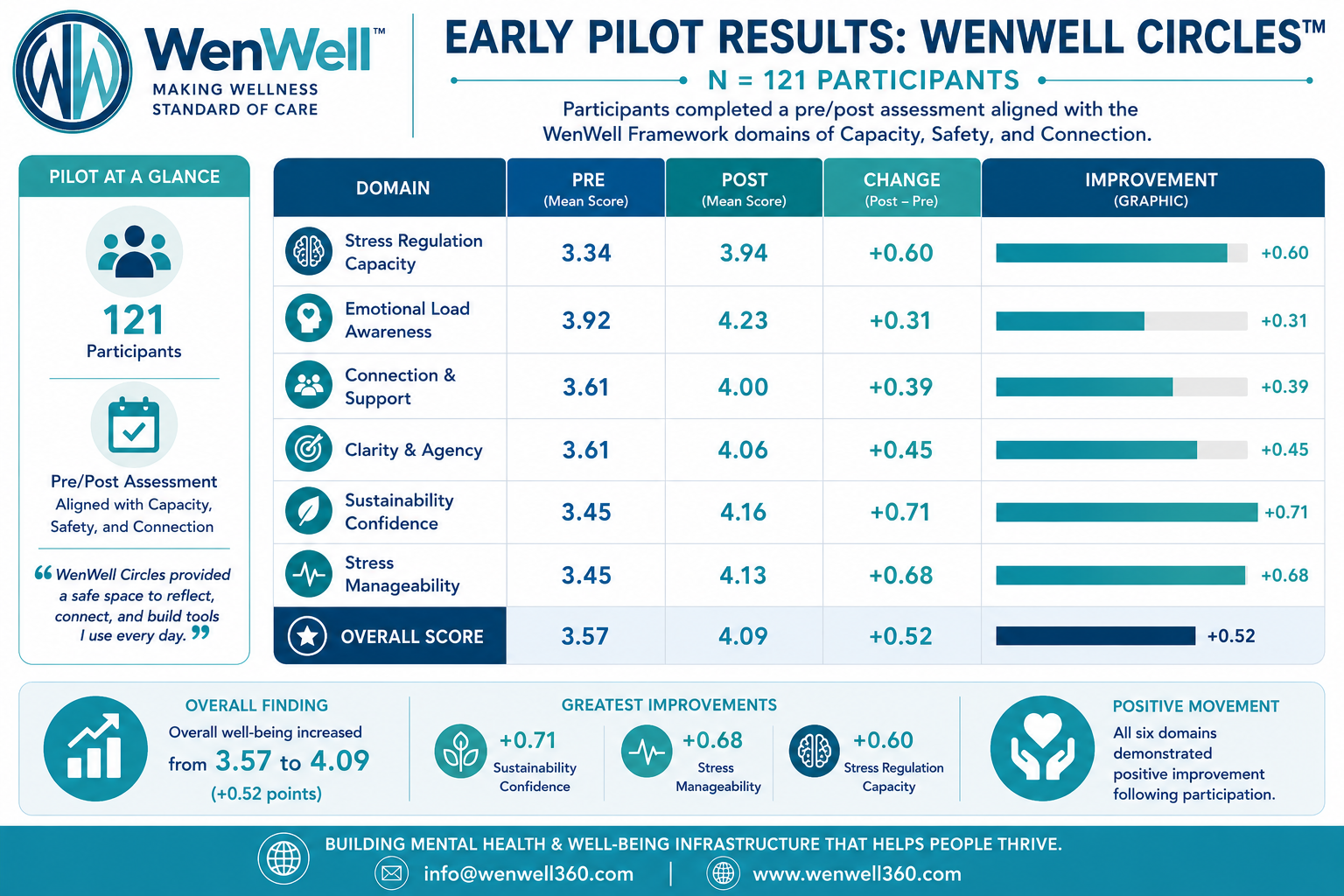
Following participation in one WenWell Circle™, overall well-being increased from 3.57 to 4.09 (+0.52). The largest improvements occurred in Sustainability Confidence (+0.71), Stress Manageability (+0.68), and Stress Regulation Capacity (+0.60). Every wellness domain demonstrated measurable improvement.
7. Key Insights
WenWell Circles™ produced meaningful, measurable improvements in well-being after a single facilitated session. The pilot also revealed several foundational insights about how organizations can build sustainable wellness infrastructure:
- Well-being Can Improve Quickly. Meaningful improvements occurred after a single facilitated session, suggesting that structured conversations can positively influence perceptions of stress, confidence, and support.
- Psychological Safety Matters. Participants consistently reported feeling more comfortable sharing experiences and connecting with peers when intentional safety practices were established.
- Connection Is a Wellness Strategy. Guided storytelling reduced isolation while strengthening empathy, trust, and belonging.
- Sustainable Wellness Requires More Than Individual Resilience. Participants reported greater confidence in maintaining healthy wellness behaviors after engaging in structured reflection, practical strategy development, and accountability.
8. Why This Matters for Organizations
Burnout is not solely an individual problem. It is also a systems challenge. Organizations need approaches that strengthen individuals while improving relationships and culture.
WenWell Circles™ provide organizations with a scalable infrastructure that is:
- Evidence-informed.
- Repeatable.
- Facilitator-led.
- Measurable.
- Adaptable across industries.
- Designed to complement existing wellness initiatives.
9. Applications
The WenWell™ Framework can be implemented across diverse environments, including:
- Healthcare systems.
- Hospitals.
- Nursing schools.
- Colleges and universities.
- Cancer centers.
- Corporate organizations.
- Government agencies.
- Community organizations.
- Nonprofit organizations.
- Faith communities.
- Caregiver support programs.
10. Building the Future of Well-Being Infrastructure
The vision for WenWell™ extends beyond individual support circles. The framework is designed to become an integrated organizational ecosystem that includes:
- WenWell Circles™.
- Certified WenWell Facilitators™.
- WenWell Champions™.
- WenWell Workshops™.
- WenWell Index™ measurement tools.
- Leadership development.
- Organizational consulting.
- Community implementation networks.
Conclusion
The WenWell Circle™ pilot provides encouraging early evidence that structured, psychologically safe wellness conversations can produce measurable improvements in stress regulation, emotional awareness, confidence, connection, and overall well-being. Following a single facilitated session, 121 participants demonstrated positive movement across every assessed wellness domain, with an overall wellness improvement of 0.52 points. These findings support continued implementation and rigorous evaluation of WenWell Circles™ as a scalable intervention capable of strengthening individuals, teams, and organizational culture. As organizations continue searching for sustainable approaches to workforce well-being, WenWell™ offers more than a wellness program — it provides a practical framework for building mental health and well-being infrastructure.
Next Steps
Organizations interested in implementing the WenWell™ Framework can begin by:
- Hosting a WenWell Circle™.
- Training Certified WenWell Facilitators™.
- Measuring organizational well-being with the WenWell Index™.
- Integrating the framework into leadership and workforce development initiatives.
- Building a sustainable culture grounded in Capacity, Psychological Safety, and Connection.
About WenWell™
WenWell™ is making wellness the standard of care by building mental health & well-being infrastructure to help people feel supported, connected, and equipped to navigate life's challenges. WenWell™ provides organizations with training and measurement tools to build sustainable cultures of Capacity, Psychological Safety, and Connection.
For partnership inquiries or to schedule a discovery conversation, contact WenWell™.
Schedule a Discovery ConversationSuggested Citation
Mayo, W. G. (2026). Building mental health & well-being infrastructure™: The WenWell™ Framework — Early pilot findings from WenWell Circles™ (N = 121 participants). WenWell Publishing™. https://www.wenwellpublishing.com/publications/wenwell-support-circles-pilot
Copyright
© 2026 WenWell™ and WenWell Publishing™. All rights reserved. WenWell™, WenWell Publishing™, WenWell Circles™, the WenWell™ Framework, Mental Health & Well-Being Infrastructure™, and Making Wellness Standard of Care™ are trademarks of WenWell™. No portion of this white paper may be reproduced, distributed, or transmitted in any form or by any means — including photocopying, recording, or other electronic or mechanical methods — without the prior written permission of the publisher, except in the case of brief quotations embodied in scholarly articles and reviews with full attribution to the author and WenWell Publishing™.
About the Author
Dr. Wendy Garvin Mayo is a doctorate-prepared oncology nurse practitioner, stress strategist, and founder of WenWell™. Her work spans clinical practice, leadership, academia, and workforce engagement, with a focus on advancing nurse wellness and mental health across healthcare systems.
Related Publications
WenWell Framework Series
The WenWell™ Wellness Index
WenWell Framework Series
The WenWell Framework™
WenWell Framework Series
The SHAPE Framework™
WenWell Framework Series
The STOPPP Method™
WenWell Circles Series
WenWell Circles™
WenWell Circles Series
WenWell Circles™: UConn Outcomes Report
WenWell Circles Series
WenWell Circles™: SCSU Outcomes Report
WenWell Circles Series
WenWell Support Sessions™: SCSU Senior Workforce Readiness
WenWell Circles Series
WenWell™ Wellness Retreat: Chi Eta Phi Sorority Impact Report
State of Nurse Wellness Series
State of Nurse Wellness™ Roundtable: 2026 Annual Report
State of Nurse Wellness Series
The Day Connecticut Made History
Family Caregiver Wellness Series
SHAPE Your Life Blueprint for Family Caregivers
Oncology Mental Health Series
Oncology Mental Health: Bridging the Gap
WenWell Circles Series
WenWell™ Executive Brief
Courageous Conversations Series
Six Steps to Productive Courageous Conversations
WenWell Framework Series
Wellness Assessment: Thriving or Surviving?
8-Minute Conversation Series
The 8-Minute Conversation™
Certified WenWell Facilitator Series
Building Multipliers